Open Educational Reports and Presentations
Recent Presentations
OER Awareness
USDLA 2023 National Conference
Session Title: Tracking OER Awareness and Adoption in US K-12 and Higher Education — Results from our 2022-23 National SurveyPresentation Time: July 19, 2023, 2:30 - 3:15 PM ET
This presentation reports the latest results from our national surveys tracking the awareness of open educational resources (OER) in US K-12 and higher education classrooms. Since 2009, Bay View Analytics has been tracking the growing awareness and adoption of OER through annual surveys of teachers, faculty, and administrators. The presentation show how OER trends vary by grade level, course discipline, and school demographics.
Download presentation slides
OLC Innovate 2023 - Featured Presentation
Session Title: Behind The Curtain For The Curricula Adoption Processes In OER And Non-OER ClassroomsPresentation Time: April 21, 2023, 11:45 AM to 12:30 PM CT
How and why are specific courseware materials chosen to be used? The curricula adoption process varies across institutions and departments. This presentation uses large-scale national survey data to look at the curricula adoption process and examine differences for OER vs. non-OER classrooms, by course level, and institution type.
Download presentation slides
OLC Innovate 2023
Session Title: Post-Pandemic Trends In U.S. Higher Education Digital And OER Textbook AdoptionsPresentation Time: Thursday, April 20, 2023, 9:30 AM to 10:15 AM CT
The use of digital materials in higher education classrooms is on the rise. Join us for a closer look at this transition from physical, print materials to a digital-first future over the last decade. We’ll discuss how we got here, and what this might mean for the future of education.
Download presentation slides
Higher Education OER Reports
Digital and OER Textbook Adoption
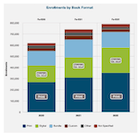
The global COVID-19 pandemic changed how faculty teach, and resulted in a large rise in digital curricula use. We partnered with the Brian Murphy Group to investigate how the digital adoption trend varied across different course disciplines. The study examines selected large-enrollment introductory-level courses for the Fall 2020, Fall 2021, and Fall 2022 terms. The shifts in perspectives on digital learning is part a growing acceptance of digital materials that we've been monitoring for years. During the 2018-2019 academic year, 44% of faculty agreed with the statement "Students learn better form print materials than they do from digital." By the 2021 - 2022 academic year, that figure dropped to 33%. In the same academic year, the majority of faculty and administrators expressed agreement with the statement "Digital materials provide greater flexibility for students." Only a small number disagree with the statement (5% faculty, 4% administrators), with only 1% of faculty strongly disagreeing.
The results show that print textbooks remain a dominant form factor. But the growing demand for digital textbooks speaks to where demand may be heading.
Faculty Satisfaction with Course Materials varies by Publisher
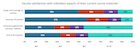
As part of our research into faculty satisfaction with curricula, we took a look at how satisfaction varies by publisher type, comparing major commercial publishers, smaller commercial publishers, and OER, and measured how OER fares across several factors. The study examines multiple aspects: overall, accuracy, scope of content, included instructor materials, and cost to student.
Turning Point for Digital Curricula: Educational Resources in U.S. Higher Education, 2022
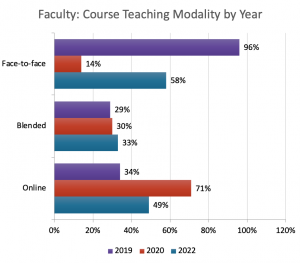
Report Infographic: Turning Point for Digital Curricula
Turning Point for Digital Curricula: Educational Resources in U.S. Higher Education, 2022 found that while almost all higher education faculty have returned to their physical classrooms this school year, their reversion to print textbooks and other instructional materials they preferred before the pandemic hasn’t been nearly as swift
Key findings from the report include:
- While students are returning to the classroom, there has not been a return to pre-pandemic levels
- Faculty and administrators have expressed a growing acceptance, and even preference for online or blended learning environments, as well as digital courseware
- 86% of administrators and 64% of faculty agree that the cost of course materials is a serious problem
- Acceptance of digital course materials has grown, along with awareness and usage of Open Educational Resources (OER)
- A measure of OER awareness as well as licensing options, has grown to 57%(up 7%) this year.
Open Educational Resources: Becoming Mainstream
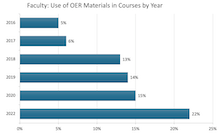
Bay View Analytics has been tracking awareness, adoption, use, and attitudes toward open educational resources in U.S. Higher Education since 2009. A lot has changed.
- OER Awareness amongst US. Higher Education faculty and administrators went from almost nonexistent in 2009, to 57% “Somewhat Aware,” “Aware,” or “Very Aware” in 2022
- The number of respondents who use OER materials as required courseware lags behind the metric for OER Awareness, but these levels also grew year over year
- OpenStax has become a viable alternative to commercial publishers
- Faculty give OER materials higher marks for quality than they do for commercial alternatives
Digital curricula acceptance and use in Higher Education varies by region
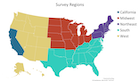
Online learning and digital tools and materials have seen increased acceptance and adoption in the US, spurred in part by online teaching experiences during the pandemic. But not all faculty agree, and opinions seem to fall along a geographic divide: acceptance of online learning is highest on the west coast, and lowest in the east.
K-12 OER Reports
Coming Back Together: Educational Resources in U.S. K-12 Education, 2022

Report Infographic: Coming Back Together Infographic
While almost all teachers have returned to their classrooms this school year, the newest Bay View Analytics report Coming Back Together: Educational Resources in U.S. K-12 Education, 2022 shows that their reversion to textbooks and other physical instructional materials they preferred before the pandemic hasn’t been nearly as swift.
More than nine in 10 teachers reported having returned to in-person instruction. But only 30 percent of teachers report their instructional materials are entirely or predominantly physical, down significantly from 2018-19 prior to the pandemic when 68 percent said physical materials were the norm.
The continued use of digital materials comes despite most teachers (61 percent) saying they prefer to use physical materials and nearly the same number (59 percent) expressing a belief that students learn better with physical materials. However, most teachers (55 percent) also believe that their students prefer digital materials.
Teachers believe the future of K-12 classroom materials is digital
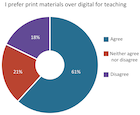
Five charts that predict a digital-first future for K-12 classrooms in the United States.
The pandemic required K-12 teachers to adopt and use digital materials as many traditional options did not work in this new remote-classroom setting. For the 2021-22 school year there was a vast return to the classroom, however, these teachers now had experience with digital tools. Will they incorporate their new digital materials with their traditional physical in-person classroom materials? Was the pandemic switch to digital a one-time blip, or does it predict more long-term adoption of digital?
2022 OER Presentations
OLC Accelerate 2022
Session Title: Is it time to say goodbye to bound textbooks?Presentation Time: November 3, 2022 - 1:45 PM to 2:30 PM ET
There is no doubt that the COVID-19 pandemic fundamentally changed higher education. One such change has been the accelerated acceptance of (and even preference for) digital course materials. This presentation uses large-scale national survey data to examine this trend and speculate on what the next few years will show.
Download presentation slides
Open Education Conference 2022
Session Title: The Changing Future of OER in U.S. Higher EducationPresentation Time: October 18, 2022 at 4:00 - 4:25PM ET
We can no longer trust previous assumptions about what factors drive the awareness and adoption of Open Educational Resources (OER) in higher education. Changes in teaching and learning brought about by the COVID-19 pandemic, and the newly adopted strategies that emerged among higher education institutions, publishers, and teaching faculty as a result of the pandemic, have drastically altered the landscape. This presentation uses data from multiple large-scale national surveys of academic administrators and teaching faculty to examine these changes and speculate on what they mean for the future of OER adoption and use.
Download presentation slides
Recorded session presentation
Open Stax
Session Title: Free the Future with OpenStax: Trends, predictions, and the evolving needs of the fieldPresentation Time: October 5, 2022 at 2:00 - 3:00PM ET
Recently, Bay View Analytics published a report on the use of open educational resources (OER) today. During this webinar, OpenStax’s Director of Higher Education Anthony Palmiotto and Dr. Jeff Seaman and Dr. Julia Seaman of Bay View Analytics will share and discuss the findings of this report. The webinar takes an engaging deep dive into OER and how it came to be, explores the growing role of OER in higher education, and examines what the future might hold in this pandemic landscape.
Download presentation slides
On demand session presentation
Cal OER Keynote
Session Title: Crunching the OER NumbersPresentation Time: August 5, 2022 9:30 - 10:45 AM PT
The latest results from Bay View Analytics’ annual survey on higher education in the US show continued growth for OER awareness following the pandemic. For the first time, the majority of faculty (57%) reported awareness of OER. Faculty use of OER has also quadrupled since 2016, with more than one in five reporting adopting OER. We’ll discuss these findings during the keynote and show how faculty in California compare to their regional colleagues.
Download presentation slides
OLC Innovate 2022
Session Title: The Three Projected Futures for Open Educations ResourcesPresentation Time: March 30, 2022 at 9:15 - 10:00AM ET
What is the future for Open Educational Resources (OER) in higher education? This presentation examined three different scenarios, noting how the future trajectory for OER has been changed: first by actions of the commercial publishers, and most recently by the global COVID-19 pandemic.
Download presentation slides
OLC Open Ed Week - How is the Pandemic Affecting the Future of OER?
Session Title: How is the Pandemic Affecting the Future of OER?Presentation Time: March 15, 2022 at 1:00PM - 2:00PM ET
How is the Pandemic Affecting the Future of OER? looked at the pandemic influence on classroom materials, from the shift to virtual learning, exposure to digital materials, and impact on student learning. The panel discussion featured a student voice from Collin-Kazu Lewis (student at Portland State University) and perspective from OER publisher from Daniel Williamson (Managing Director at OpenStax).
Download presentation slides
Watch the seminar recording
OLC Open Ed Week - OER Initiatives
Session Title: The Ease of Growing OER AdoptionPresentation Time: March 8, 2022 at 1:00PM - 2:00PM ET
Bay View Analytics research has shown that faculty members who are aware of an Open Education Resources (OER) initiative are 300%+ more likely to adopt OER than are the general population of faculty. This webinar examines the data behind this finding and introduces several individuals who have made this difference a reality.Attendees will leave with an understanding of successful strategies and the next steps that they can apply at their institution.
Download presentation slides
Watch the seminar recording
Recent Publications
Course Material Affordability
- 2023 National Course Materials Survey
- Pennsylvania Course Materials Survey 2023
- Pennsylvania Course Materials Presentation
- Course Material Webinar Slides
Open Educational Resources
- Digitally Established: Educational Resources in U.S. Higher Education, 2023
- Curricula of Many Sources: Educational Resources in U.S. K-12, 2023
- Research Brief: Digital and OER Textbook Adoption
- Research Brief: Faculty Satisfaction with Course Materials varies by Publisher
Digital Learning Pulse Surveys
- Infographic: 2023-2024 Digital Learning Pulse Survey
- The Digital Transformation of the Community College
- Planning for a Smaller Future: Dealing with Declining Enrollments
STEM
- Teaching Online: STEM Education in the Time of COVID
- What Makes a STEM Student
- Perceptions of the Future of STEM Education
Distance Education
- Digital Faculty: Faculty Social Media Use and Communications
- Infographic: Digital Faculty
- Grade Increase: Tracking Distance Education in the United States
Follow us on
 Twitter and
  LinkedIn.
Privacy
All survey respondents are provided complete anonymity. No personally identifiable information is released. Full privacy policy.