Deeply Digital
Download full report as a PDF file: is released under a Creative Commons Attribution 4.0 International (CC BY 4.0).
Acknowledgements
The ongoing support from the William and Flora Hewlett Foundation makes these reports possible, and we are thankful for their continuing guidance. We're also grateful to the Online Learning Consortium, who has served as administrator for our grant and provided invaluable feedback.This project would not be possible without the faculty and administrators — over 3,000 respondents — who completed our survey. We review every response and read every submitted comment and have included some in this report with permission. Each quote is as close to the original as possible; modifications were made only to remove personally identifying information or correct obvious typos.
The project also received great support from the open education community, who offered feedback and advice throughout the course of this project. Particularly, the Texas Higher Education Coordinating Board (THECB) and Midwestern Higher Education Compact (MHEC) helped with dissemination and communication of the surveys to their members. We thank them for helping to improve the final version.
This report would not have been possible without support from our colleagues. We thank Nate Ralph for his extensive copy editing, I. Elaine Allen for feedback throughout the process, and Mark Favazza for designing the report cover.
Finally, we also want to thank everyone who reads this report. Your comments and feedback help shape the future of this project and are always appreciated.
Julia E. Seaman
Jeff Seaman
Bay View Analytics
2025
Executive Summary
This is the 14th report in a series of surveys tracking curricula discovery, selection, and adoption processes in U.S. higher education. The surveys have tracked the growth of digital materials and open educational resources (OER) in higher education classrooms since 2009, providing trends on adoption and sentiments. The results also covered the abrupt transitions to remote teaching and the return to in-person instruction during and following the COVID-19 pandemic.The survey responses for this analysis were collected in April 2025, from a total of 3,447 faculty. The respondents come from all 50 U.S. states, the District of Columbia, and the Virgin Islands.
The key takeaways from this year’s survey are:
· Post-Pandemic Shifts: Institutions have stabilized hybrid models after pandemic-era spikes in online learning, with blended and fully online courses and digital tools becoming integral, despite a decline in fully online courses from their pandemic peak.
· Curricula Material Formats: Faculty find benefits in both print and digital formats, and the majority offer both to students, though required textbooks are more likely to be available digitally compared to print.
· Curricula Material Rating: Overall, faculty give positive ratings to their materials, with higher grades related to content and lower ones related to costs; faculty using required textbooks available in a digital format give slightly higher ratings overall than those using print-only.
· OER Awareness and Adoption: OER awareness rose slightly this year, with an even larger rise in the number of faculty using OER as required course materials; the increased use is reflected in faculty ratings as OER materials receive more "A" grades compared to commercial publishers.
Study Results
Teaching Modalities
Face-to-face instruction remains dominant, with fully online and blended model courses maintaining steady presences, reflecting the post-pandemic adaptation and hybrid learning persistence.
We asked our respondents to describe how they were currently teaching during the 2024-25 academic year.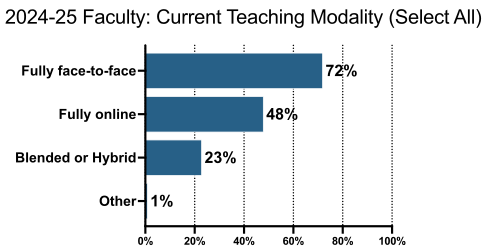
The most common teaching modality for the 2024-25 academic year were fully face-to-face courses, with 72% of faculty teaching at least one course fully face-to-face. A smaller percentage of faculty (48%) taught at least one course that was fully online, where no instruction was done in-person. Blended courses, mixing both online and in-person instruction in some form, were less common — just 23% of faculty taught at least one blended course.
Faculty generally teach more than one course during an academic term, and they may not share the same format. A faculty member might teach two versions of the same course — one fully face-to-face, the other fully online. Or they might teach one course subject online and another that features an in-person lab component.
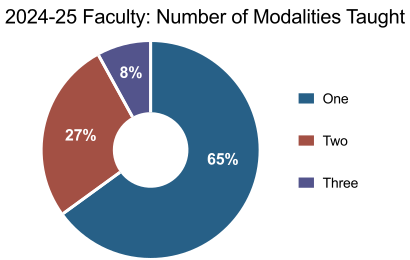
For the 2024-25 academic year, 65% of respondents indicated that all their courses were offered in just one modality. The remaining faculty members were split between teaching two modalities (27%) and all three modalities (8%). This is almost identical to the previous year's data, where 66% taught exclusively in one modality, 26% taught across two modalities, and 8% utilized all three modalities.
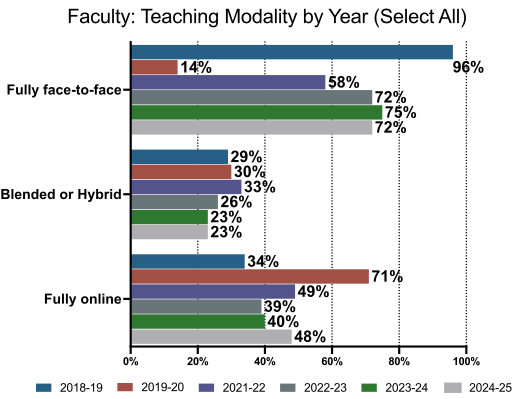
In recent years, there have been notable shifts in teaching modalities as educators and institutions adapt to changing circumstances. In the 2024-25 academic year, the majority of instruction remained predominantly face-to-face, with 72% of courses being taught in this manner. This represents a slight decrease from the previous year, 2023-24, where 75% of teaching was in-person, and the same as 2022-23. This suggests a stabilization in the return to traditional classroom settings after the disruptions caused by the pandemic.
Blended or hybrid learning models have remained relatively stable in recent years. In both 2024-25 and 2023-24, this mode accounted for 23% of courses, demonstrating consistency after a slight drop from 26% in the previous year. The trend had been gradually declining since 2018-19, when it accounted for 29% of teaching modalities. This suggests that many institutions have settled into hybrid models without further shifts, potentially reflecting a balance between the advantages of in-person learning and the flexibility of online offerings.
On the other hand, fully online courses experienced an initial decline from 71% to 49% in 2021-22, then dropped further to 40% in 2023-24 and 39% in 2022-23, before rising again to 48% in 2024-25. This increase in the current year may indicate new changes in institutions supporting fully online instruction, in addition to the pandemic's impact over the past few years.
Overall, these trends illustrate an initial post-pandemic shift back toward face-to-face instruction, which then stayed relatively stable over the next three years. There has been a steady use of blended models throughout the period, along with a persistent and possibly growing presence of fully online courses. The shifts reflect broader changes in educational preferences, technological progress, and ongoing reactions to global events like the COVID-19 pandemic. As institutions continue to adapt, it is likely that these modes of instruction will keep evolving to meet both logistical challenges and pedagogical innovations.
Textbook Formats
The majority of faculty provide format options for students, with the sustained shift towards digital formats, as 9 in 10 required textbooks are now available digitally.
“I don't have an assigned book for the course, but instead assign students a selection of published essays and criticism, all of which are made available to them through links or PDF files (or via the library, for materials that aren't freely available online)."
“I am the author of the textbook so it has everything I want in the course. It’s available for free online."
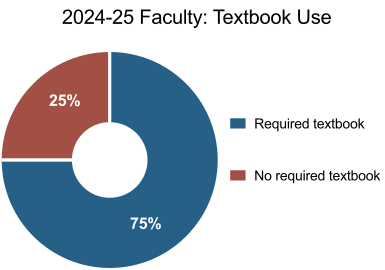
For the 2024-25 academic year, 75% of faculty reported requiring a textbook for their largest-enrolled courses, while 25% did not.
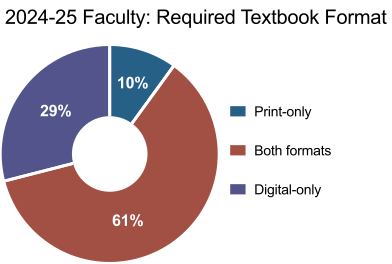
In the 2024-25 academic year, 29% of courses offered a textbook exclusively in a digital format, while 10% provided only print versions. The majority, at 61%, offered the textbook in both print and digital formats. However, it is important to note that while faculty often choose the specific textbook, they may have less direct control over the formats available. Publishers often provide the textbooks to the institutional bookstores and students directly in both formats. Additionally, the faculty are reporting how the textbook was officially offered, not necessarily the formats students preferred, used, purchased, or found.
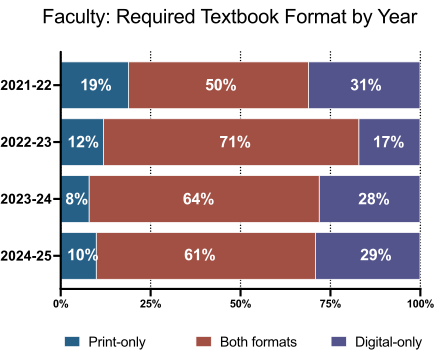
In the 2024-25 academic year, the trend of offering textbooks in various formats continued its evolution. Ten percent of courses offered a textbook exclusively in print format, a slight increase from the previous year's 8%, but lower than earlier figures. In comparison, 29% of courses offered textbooks as digital-only, a similar level to that seen in previous years.
The majority, at 61%, provided textbooks in both print and digital formats. This marks a decline from 71% in 2023-24, yet it remains the most common option for faculty. In the post-pandemic years, offering both formats has consistently been prevalent, with figures ranging between 50% to 71% over recent years.
Looking at past trends, there was a notable decline in courses that only offered print textbooks—from nearly one-fifth (19%) in 2021-22 to 10% in 2024-25. This represents a clear shift toward adopting digital formats over time, while still allowing some traditional print options for faculty and students.
Perspectives on Digital versus Print
Faculty hold nuanced views on format preferences, acknowledging benefits to both print and digital materials for students.
“The textbook for my course is only $25 to purchase (either print or digital) and less than that to rent, so I'm lucky that most of my students do obtain the textbook... However, I find myself returning to printed handouts more and more in class in order to force students to close their laptops and put down their phones... I love technology! But I also need my students to pay attention and learn while they are in class."
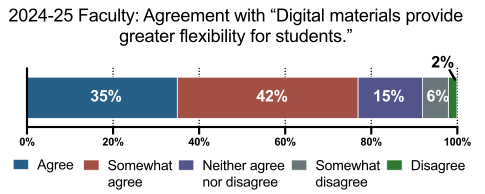
Additionally, 15% of the faculty indicated that they neither agree nor disagree with this statement, and those expressing disagreement comprised 8%, with 6% choosing "somewhat disagree" and 2% selecting "disagree."
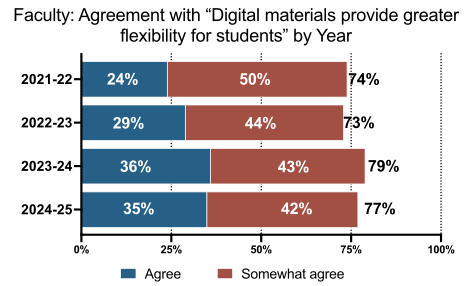
This represents a slight change from earlier figures but maintains the general consensus that digital materials offer greater flexibility.
Approximately three-quarters of faculty members either "agreed" or "somewhat agreed" that digital materials provide more flexibility for students, showing a strong belief in their flexibility. This belief has been strengthening over time, with the proportion of faculty reporting that they "Agree" increasing by 6% from earlier periods, suggesting that more faculty members are recognizing and experiencing the benefits of digital materials for their students.
Overall, while there has been a modest recent decrease in total agreement this year, the trend over several years shows increasing recognition among faculty of the advantages offered by digital formats.
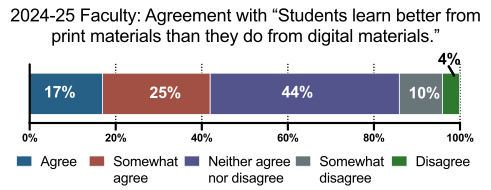
In the 2024-25 academic year, faculty expressed their opinions on whether students learn better from print versus digital materials. Overall, 17% of faculty "agree" with the statement that students learn better from print materials, while a further 25% "somewhat agree," totaling 42% who express a preference for print.
A notable portion of faculty remains neutral on this issue; 44% selected "neither agree nor disagree." Meanwhile, those expressing disagreement with the statement are 14%, with 10% choosing "somewhat disagree" and 4% selecting "disagree."
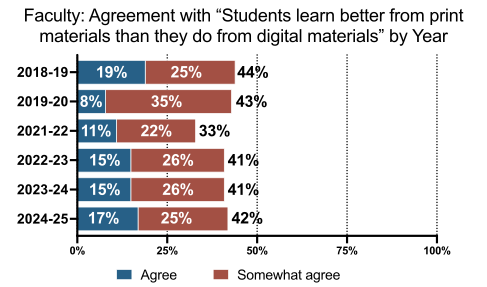
Overall agreement with the statement has remained consistent year over year, hovering around 41-44% since 2018-19. However, there was a notable exception of a large drop to 33% immediately following the pandemic, possibly indicating optimism about the widespread adoption of new digital materials at that time.
In the most recent academic year, 2024-25, faculty agreement with the statement showed a modest increase in those who "agree" outright. Specifically, the percentage of faculty who fully agreed rose to 17%, marking a gradual upward trend over recent years, from a low point of 8% in 2019-20.
Faculty commentary on the subject of print versus digital materials tends to revolve around price: comments lamented the lack of affordable textbooks, with high prices being a compelling reason to use digital texts. And while digital texts aren't explicitly called out as inferior, comments suggest that distraction, information retention, and ownership (versus renting) are reasons to stick to print.
Curricula Satisfaction
Faculty report overall positive satisfaction with their current curricula materials, although grades vary depending on specific criteria, format, or publisher.
"While content is complete and accurate the text is not very "readable" for non-majors."
"I really have no problem with our textbook. We have been using the various editions of this textbook since 2012 and as a department we have been happy with it throughout."
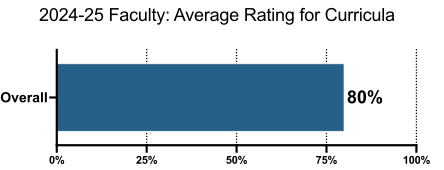
The average overall rating for curricula was 80%, showing that higher education faculty are generally satisfied with their curricula.
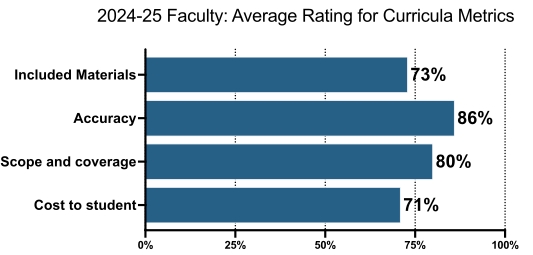
Faculty were asked to rate their curricula across several metrics. The respondents gave an average rating of 86% for their curricula's accuracy and 80% for their scope and coverage. They rated their curricula's included materials at 73%, while the average rating for the curricula's cost to students was 71%.
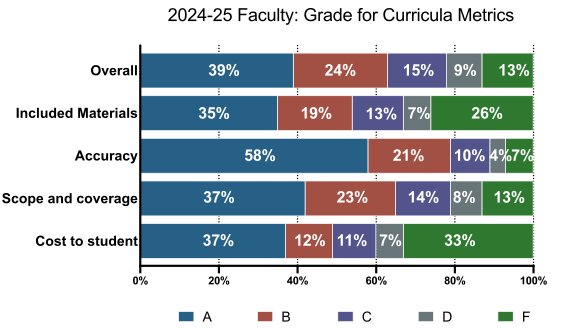
Examining the distribution of faculty grades for their curriculum materials reveals more details. All metrics showed a range of grades, from As to failing. The faculty respondents considered their curriculum's accuracy the best scores, with 58% awarding it an A. The cost to students was the least well regarded, with 33% of respondents assigning an F. The included materials had the most divided grades, possibly reflecting the variety of products, with 35% earning an A and 26% an F.
AI-generated content may be incorrect.">
When comparing curricula satisfaction by format, digital materials receive slightly higher grades than print. Faculty using print-only textbooks for their course gave an average rating of 76%. Faculty with digital-only or both formats had average rating of 80% and 79%, respectively.
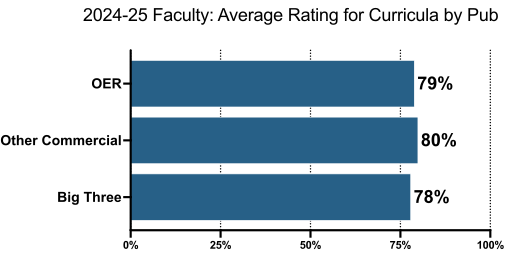
Faculty respondents generally gave positive and similar average ratings for curricula across publishers. The "Big Three" (Cengage, McGraw, and Pearson), named as they combined encompass the majority of the textbook market, received 78%, open educational resources (OER) curricula had an average rating of 79%, while other commercial publishers were rated slightly higher at 80%.
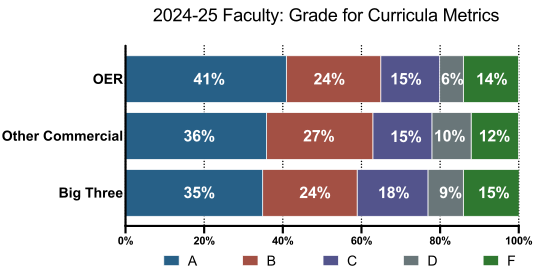
There are greater differences when examining the proportions of grades assigned to materials by publishers. While the "Big Three" publishers received the highest average ratings, OER received the most A grades, at 41%. The Big Three received the most F ratings at 15%, just one percentage point higher than OER's 14%. All other commercial publishers ranked between the two for A grades but had slightly fewer failing ratings at 12%.
According to the open-ended comments, faculty appreciate value. The respondents' opinions centered on appreciation for educational resources that are affordable, from inexpensive textbooks to free or low-cost alternative materials that help reduce the financial burden that students face. This assumes that faculty can find content that meet their needs: some responses lament outdated textbooks, dense, inflexible materials, or (once again) high costs. Ancillary materials (videos, online homework components, problem / example sets, etc.) are also highly prized, as limited or non-existent instructor resources can make it difficult to grade and teach effectively.
OER Awareness
Three in five faculty are aware of OER, and faculty awareness of OER showed a small rebound with a slight increase this year.
“I like the concept. The materials I have found tend to be shoddy. Superficially okay but with no depth."
“I'm ALL for it. It makes education more accessible."
“Some OER materials are designed well and others are not very good. You have to evaluate them just like you evaluate textbooks."
Measuring the awareness and use of OER materials isn't straightforward. Many educators will adopt materials without fully understanding the licensing details, often misunderstanding what makes OER unique. Also, some may think “open" and "free" mean the same, assuming all free resources are OER.
To gauge awareness of OER, reports in this series have used a consistent question, which has proven to have the best balance in differentiating among the varying levels of awareness without confusing those with no prior knowledge of the concept. The specific wording has remained consistent to enable comparisons across years with earlier surveys. Additionally, the measure of OER awareness combines responses to Creative Commons licensing and OER awareness questions to ensure high-quality results.
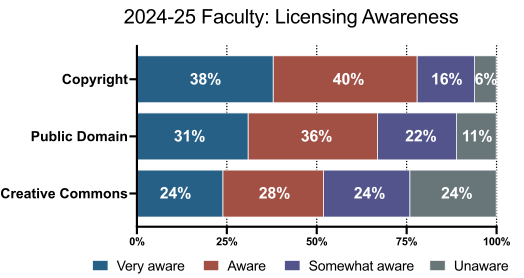
Faculty awareness varies by the type of licensing. Faculty are most aware of copyright, with 94% at any level of awareness, a slight decrease from 96% during the 2023-24 academic year. That's followed by awareness of public domain at 89%, similar to 90% in 2023-24. Finally, awareness of Creative Commons licensing remained constant year-over-year, at 76%.
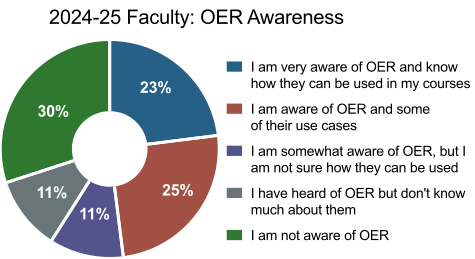
In 2024-25, 59% of faculty were aware of OER at any level. Eleven percent were “somewhat aware,” 25% were “aware,” and 23% were “very aware.” For faculty who were unaware, 11% reported that they had “heard of” OER, indicating they have some name recognition but no further familiarity. Thirty percent of faculty are unaware of OER.
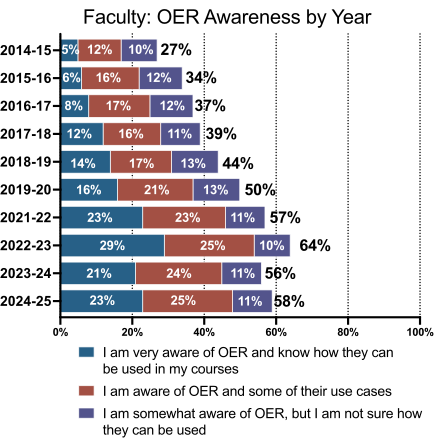
For eight consecutive years, beginning in 2014-15, OER awareness increased year over year. The overall level of awareness more than doubled from 27% to a peak of 64% in 2022-23. The growth stemmed from both increases in "aware" and "very aware" categories. The 2023-24 academic year was the first decrease in awareness, as it fell 8% to 56%.
Faculty awareness of OER in 2024-25 shows a slight rebound, with 23% of faculty reporting they are “very aware” of OER, up from 21% in 2023-24, although still below 29% in 2022-23. While the “very aware” category has decreased since 2022-23, the 2024-25 data indicate a modest recovery. The “aware” and “somewhat aware” categories remain relatively stable at 25% and 11%, respectively, reflecting consistent engagement with OER concepts over the past three years.
OER Use
Evidence of growing acceptance of OER as usage increased, with one-third of faculty using OER as required materials in their classrooms.
“I feel good saving students money."
“The quality of materials varies greatly. I am open to their use but they have to align with my teaching goals."
“I have colleagues who would rather use a [commercial] textbook. I dread the day that I am outvoted."
“I honestly would love to switch to an OER but I have yet to find one that is remotely close to the quality of publisher books."
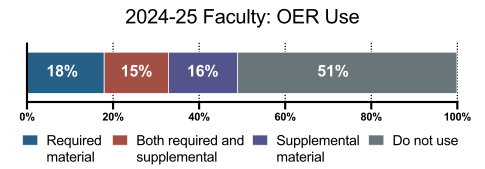
In 2024-25, 49% of faculty report using OER materials in at least one of their courses, up from 41% in the 2023-24 academic year. These uses can include any type of classroom material, such as textbooks, homework, interactive activities, and more. These responses are by individual faculty, not by course: for this question, faculty can teach multiple courses and use OER in only one, or across all of them.
One-third of faculty report using OER as a required material in their courses, an increase from 26% in 2024-25. Fifteen percent of faculty now use OER as both supplemental and required materials, up from 10% in 2023-24.
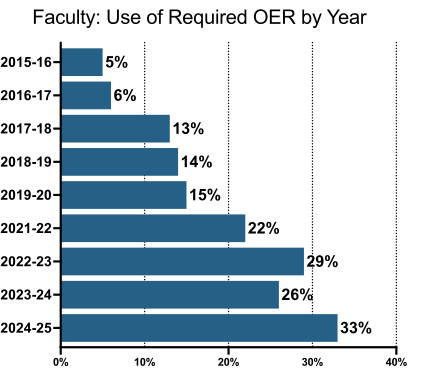
Faculty use of OER as required course materials has increased 7% year over year. This reverses the slight decline observed in 2023-24 and marks the highest level recorded to date.
While the comments from faculty respondents feature enthusiasm for the concept of OER, there are significant challenges and concerns that provide a barrier to adoption. The idea that "you get what you pay for" was a recurring refrain in the comments, reflected in concerns about the legitimacy and value of OER materials.
That said, the respondents value the accessibility, cost-effectiveness, ease of use, customization, and collaboration aspects of OER, with several commentors expressing enthusiasm for contributing their own time and / or resources to support OER development and dissemination.
Summary
These survey results highlight a gradual return to traditional face-to-face instruction, in conjunction with a significant presence of blended and digital learning models. These shifts underscore a post-pandemic trend toward hybrid models, balancing in-person benefits with the flexibility of digital tools.Faculty often teach multiple courses with varying formats, reflecting institutional adaptations to diverse student needs and logistical constraints. While face-to-face instruction remains dominant, the integration of digital and blended models continues to expand, alongside growing OER adoption. However, sustaining high levels of OER awareness and addressing disparities in resource access remain critical challenges for higher education institutions aiming to meet the needs of diverse learners.
Textbook formats also show a clear transition toward digital accessibility. Faculty recognize the flexibility of digital materials, and outright preferences for print materials have waned, alongside a growth in neutrality in learning preferences. These trends indicate a broader acceptance of digital tools, though concerns about student learning outcomes persist.
Finally, OER awareness and use have also advanced, with faculty’s use of OER as required course materials reaching an all-time high. Faculty cite OER’s cost-effectiveness and adaptability as key advantages, though the broader adoption of OER faces hurdles in institutional support and educator familiarity. The findings highlight the need for ongoing investment in training, infrastructure, and policy frameworks to support equitable and effective educational practices.
Next Steps
This project aims to track and follow the trends of digital adoption and perceptions in U.S. higher education. The choice to use a specific textbook in a specific format is often not an isolated decision and may be affected by many other factors outside the faculty's preference for their own classrooms. Department policies, student preferences, institutional guidelines, state laws, material costs, and publisher reputation may all play a role. Therefore, this project will continue to track the specific use and adoption of digital and OER textbooks within the bigger picture.This report represents just a portion of the survey results. Additional reports, research briefs, and presentations will be released on other topics in the survey. Some planned topics includes opinions from faculty and administrators on AI, professional development, and student perspectives. All future publications will be available on our website: bayviewanalytics.com/OER.
Methodology
This survey was conducted in April 2024, with a total of 3,447 faculty responses. The respondents come from all 50 states, the District of Columbia and the Virgin Islands.The data for this report comes from survey results using a national sample of teaching faculty. The sample is representative of the broad range of teaching faculty in U.S. higher education. The sample selection process was multi-stage. The process began by obtaining data from several commercial list sources that were the combined with a faculty panel assembled by Bay View Analytics. The first step selected all faculty who taught at least one course. Individuals were then randomly selected from the master list in proportion to the number contained in each Carnegie Classification, to produce a second-stage selection of teaching faculty and department chairpersons. The resulting lists were checked against opt-out lists, as well as for non-functioning email addresses.
The respondents represent the full range of higher education institutions (two-year, four-year, all Carnegie classifications, and public, private nonprofit, and for-profit) and the complete range of faculty (full- and part-time, tenured or not, and all disciplines). Respondents represent 1,415 different institutions.
Institutional descriptive data come from the National Center for Educational Statistics’ IPEDS database.[1] After the data were compiled and merged with the IPEDS database, respondents and nonrespondents were compared to ensure that the survey results reflected the characteristics of the entire population of faculty. The responses were compared for 35 unique categories based on the 2015 Carnegie Classification of Institutions of Higher Education.
As noted in our previous reports, the specific wording of questions is critical in measuring the level of OER awareness. The language for this report (provided below) matches that used in previous reports in this series. It was found to have the best balance in differentiating amongst different levels of awareness, while avoiding leading those with no prior knowledge of the concept.
How aware are you of Open Educational Resources (OER)? OER is defined as "teaching, learning, and research resources that reside in the public domain or have been released under an intellectual property license that permits their free use and re-purposing by others." Unlike traditionally copyrighted material, these resources are available for "open" use, which means users can edit, modify, customize, and share them.
I am not aware of OER
I have heard of OER, but don't know much about them
I am somewhat aware of OER but I am not sure how they can be used
I am aware of OER and some of their use cases
I am very aware of OER and know how they can be used in the" classroom
This question may still slightly overstate the level of OER awareness, so we also ask a series of additional questions. Because licensing for remixing and reuse is central to the concept of OER, a question about the respondent’s awareness of different legal permissions was asked of all respondents before any questions about OER awareness itself:
How aware are you of each of the following licensing mechanisms?
| Unaware | Somewhat Aware | Aware | Very Aware | |
|---|---|---|---|---|
| Public Domain | ||||
| Copyright | ||||
| Creative Commons |
By combining the responses from the OER awareness question with those of the licensing questions, a combined index of awareness is constructed. An identical process was used in previous reports in this series, to permit year-over-year comparisons and trend analysis.
Definitions
This study explores how faculty members select and use the educational materials used in their courses. The primary sample represents all teaching faculty across all types of degree-granting higher education institutions in the United States. The most common educational material employed in a course is the required textbook: faculty members typically choose one or more books that all students use throughout the course. Faculty also employ a wide range of other materials — some optional, others required for all students. This study focuses on the required materials, using the following definition:Items listed in the course syllabus as required for all students, either acquired on their own or provided to all students through a materials fee; examples include printed or digital textbooks, other course-complete printed (course pack) or digital materials, or materials such as laboratory supplies.
In addition to examining the overall resource selection process, this study also explores the class of materials classified as Open Educational Resources (OER). The definition presented to the respondents in the study’s questionnaire comes from the William and Flora Hewlett Foundation:
OER are teaching, learning, and research resources that reside in the public domain or have been released under an intellectual property license that permits their free use and re-purposing by others. Open educational resources include full courses, course materials, modules, textbooks, streaming videos, tests, software, and any other tools, materials, or techniques used to support access to knowledge.[2]
An essential aspect of examining the use of educational resources is the licensing status of such materials: who owns the rights to use and distribute the material, and does the faculty member have the right to modify, reuse, or redistribute said content? The legal mechanism that faculty are most familiar with is that of copyright. The U.S. Copyright Office defines copyright as:
A form of protection provided by the laws of the United States for "original works of authorship", including literary, dramatic, musical, architectural, cartographic, choreographic, pantomimic, pictorial, graphic, sculptural, and audiovisual creations. "Copyright" literally means the right to copy but has come to mean that body of exclusive rights granted by law to copyright owners for protection of their work. … Copyright covers both published and unpublished works.[3]
Of particular interest for this study is the copyright status of the textual material (including textbooks) that faculty select as required materials for their courses.
Copyright owners have the right to control the reproduction of their work, including the right to receive payment for that reproduction. An author may grant or sell those rights to others, including publishers or recording companies.[4]
Not all material is copyrighted. Some content may be ineligible for copyright, copyrights may have expired, or authors may have dedicated their content to the public domain (e.g., using Creative Commons public domain dedication[5]).
Public domain is a designation for content that is not protected by any copyright law or other restriction and may be freely copied, shared, altered, and republished by anyone. The designation means, essentially, that the content belongs to the community at large.[6]
Materials can also be released under a Creative Commons license, which is not an alternative to copyright, but rather a modification of the traditional copyright license that grants some rights to the public.
The Creative Commons (CC) open licenses give everyone from individual authors to governments and institutions a simple, standardized way to grant copyright permissions to their creative work. CC licenses allow creators to retain copyright while allowing others to copy, distribute, and make some uses of their work per the terms of the license. CC licenses ensure authors get credit (attribution) for their work, work globally, and last as long as applicable copyright lasts. CC licenses do not affect freedoms (e.g., fair use rights) that the law grants to users of creative works otherwise protected by copyright.[7]
The most common way to openly license copyrighted education materials — making them OER — is to add a Creative Commons (CC) license to the educational resource. CC licenses are standardized, free-to-use, open copyright licenses.[8]
Appendix Tables
In-Person and Remote Teaching
| Faculty: Teaching Modality (Select All) | |
|---|---|
| Other | 1% |
| Blended or Hybrid | 23% |
| Fully online | 48% |
| Fully face-to-face | 72% |
| Faculty: Number of Teaching Modalities | |
|---|---|
| One | 65% |
| Two | 27% |
| Three | 8% |
| Faculty: Teaching Modality by Year | ||||||
|---|---|---|---|---|---|---|
| 2018-19 | 2019-20 | 2021-22 | 2022-23 | 2023-24 | 2024-25 | |
| Fully online | 34% | 71% | 49% | 39% | 40% | 48% |
| Blended or Hybrid | 29% | 30% | 33% | 26% | 23% | 23% |
| Fully face-to-face | 96% | 14% | 58% | 72% | 75% | 72% |
Textbook Formats
| Faculty: Required Textbook in Class | |
|---|---|
| Required textbook | 75% |
| No required textbook | 25% |
| Faculty: Required Textbook Format | |
|---|---|
| Print-only | 10% |
| Both formats | 61% |
| Digital-only | 29% |
| Faculty: Textbook Format by Year | ||||
|---|---|---|---|---|
| 2024-25 | 2023-24 | 2022-23 | 2021-22 | |
| Print-Only | 10% | 8% | 12% | 19% |
| Both | 61% | 64% | 71% | 50% |
| Digital-Only | 29% | 28% | 17% | 31% |
Perception of Digital versus Print
| Faculty: Agreement with statements | ||
|---|---|---|
| Students learn better from print materials than they do from digital | Digital materials provide greater flexibility for students | |
| Agree | 17% | 35% |
| Somewhat agree | 25% | 42% |
| Neither agree nor disagree | 44% | 15% |
| Somewhat disagree | 10% | 6% |
| Disagree | 4% | 2% |
| Faculty: Agreement with statement by Year | ||||||
|---|---|---|---|---|---|---|
| Students learn better from print materials than they do from digital | ||||||
| 2018-19 | 2019-20 | 2021-22 | 2022-23 | 2023-24 | 2024-25 | |
| Agree | 19% | 8% | 11% | 15% | 15% | 17% |
| Somewhat agree | 25% | 35% | 22% | 26% | 26% | 25% |
| Faculty: Agreement with statement by Year | ||||
|---|---|---|---|---|
| Digital materials provide greater flexibility for students | ||||
| 2021-22 | 2022-23 | 2023-24 | 2024-25 | |
| Agree | 24% | 29% | 36% | 35% |
| Somewhat agree | 50% | 44% | 43% | 42% |
Curricula Satisfaction
| Faculty: Average Rating for Curricula | |
|---|---|
| Overall | 80% |
| Included Materials | 73% |
| Accuracy | 86% |
| Scope and coverage | 80% |
| Cost to student | 71% |
| Faculty: Average Rating for Curricula | |||||
|---|---|---|---|---|---|
| A | B | C | D | F | |
| Overall | 39% | 24% | 15% | 9% | 13% |
| Included Materials | 35% | 19% | 13% | 7% | 26% |
| Accuracy | 58% | 21% | 10% | 4% | 7% |
| Scope and coverage | 37% | 23% | 14% | 8% | 13% |
| Cost to student | 37% | 12% | 11% | 7% | 33% |
| Faculty: Average Rating for Curricula by Format | |
|---|---|
| Digital-only | 80% |
| Both formats | 79% |
| Print-only | 76% |
| Faculty: Average Rating for Publisher Group | |||||
|---|---|---|---|---|---|
| A | B | C | D | F | |
| OER | 41% | 24% | 15% | 6% | 14% |
| Other Commercial | 36% | 27% | 15% | 10% | 12% |
| Big Three | 35% | 24% | 18% | 9% | 15% |
OER and Licensing Awareness
| Faculty: Awareness of Licensing | ||||
|---|---|---|---|---|
| Very Aware | Aware | Somewhat Aware | Unaware | |
| Creative Commons | 24% | 28% | 24% | 24% |
| Public Domain | 31% | 36% | 22% | 11% |
| Copyright | 38% | 40% | 16% | 6% |
| Faculty: OER Awareness | |
|---|---|
| I am very aware of OER and know how they can be used in the classroom | 23% |
| I am aware of OER and some of their use cases | 25% |
| I am somewhat aware of OER but I am not sure how they can be used | 11% |
| I have heard of OER, but don't know much about them | 11% |
| I am not aware of OER | 30% |
| Faculty: OER Awareness by Year | ||||||||||
|---|---|---|---|---|---|---|---|---|---|---|
| 2014-15 | 2015-16 | 2016-17 | 2017-18 | 2018-19 | 2019-20 | 2021-22 | 2022-23 | 2023-24 | 2024-25 | |
| Very Aware | 5% | 6% | 8% | 12% | 14% | 16% | 23% | 29% | 21% | 23% |
| Aware | 12% | 16% | 17% | 16% | 17% | 21% | 23% | 25% | 24% | 25% |
| Somewhat Aware | 10% | 12% | 12% | 11% | 13% | 13% | 11% | 10% | 11% | 11% |
OER Use
| Faculty: OER Use | |
|---|---|
| Required Material | 18% |
| Both Required and Supplemental Material | 15% |
| Supplemental Material | 16% |
| Do Not Use | 51% |
| Faculty: OER Use by Year | |||||||||
|---|---|---|---|---|---|---|---|---|---|
| 2015-16 | 2016-17 | 2017-18 | 2018-19 | 2019-20 | 2021-22 | 2022-23 | 2023-24 | 2024-25 | |
| Required Use | 5% | 6% | 13% | 14% | 15% | 22% | 29% | 26% | 33% |
[1] http://nces.ed.gov/ipeds/datacenter/
[2] http://www.hewlett.org/programs/education-program/open-educational-resources.
[3] http://www.copyright.gov/help/faq/definitions.html
[4] http://legal-dictionary.thefreedictionary.com/copyright
[5] https://creativecommons.org/publicdomain/zero/1.0/
[6] http://whatis.techtarget.com/definition/public-domain
[7] Personal communication from Cable Green, Ph.D., Director of Open Education, Creative Commons
[8] State of the Commons report: https://stateof.creativecommons.org
Recent Publications
Course Material Affordability
- 2025 Virginia Course Materials Survey: Executive Summary (pdf)
- 2025 Virginia Course Materials Survey: Results & Findings (pdf)
- 2023 National Course Materials Survey (pdf)
- Pennsylvania Course Materials Survey 2023 (pdf)
Open Educational Resources
- Deeply Digital: Educational Resources in U.S. Higher Education, 2025 (pdf)
- Mixed Marks for Classroom Resources Educational Resources in U.S. K-12 Education, 2025 (pdf)
- Research Brief: Digital and OER Textbook Adoption
- Research Brief: Faculty Satisfaction with Course Materials varies by Publisher
Digital Learning Pulse Surveys
- Infographic: 2023-2024 Digital Learning Pulse Survey (pdf)
- The Digital Transformation of the Community College (pdf)
- Planning for a Smaller Future: Dealing with Declining Enrollments (pdf)
STEM
- Teaching Online: STEM Education in the Time of COVID (pdf)
- What Makes a STEM Student
- Perceptions of the Future of STEM Education
Distance Education
- Digital Faculty: Faculty Social Media Use and Communications (pdf)
- Infographic: Digital Faculty (pdf)
- Grade Increase: Tracking Distance Education in the United States (pdf)
Follow us on
 Twitter and
  LinkedIn.
Privacy
All survey respondents are provided complete anonymity. No personally identifiable information is released. Full privacy policy.